The European honeybee is the bee most Australians can name and the bee most orchards can hire. It is not the bee this country evolved with. Several thousand native species — the number moves as taxonomists finish arguing — were already here, in resin, in clay, in hollow twigs, in the ground, in a social colony the size of a mango. A backyard will not save them. A backyard can stop being a desert with a lemon tree and a weekly fog of something that promises to "keep the pests down".
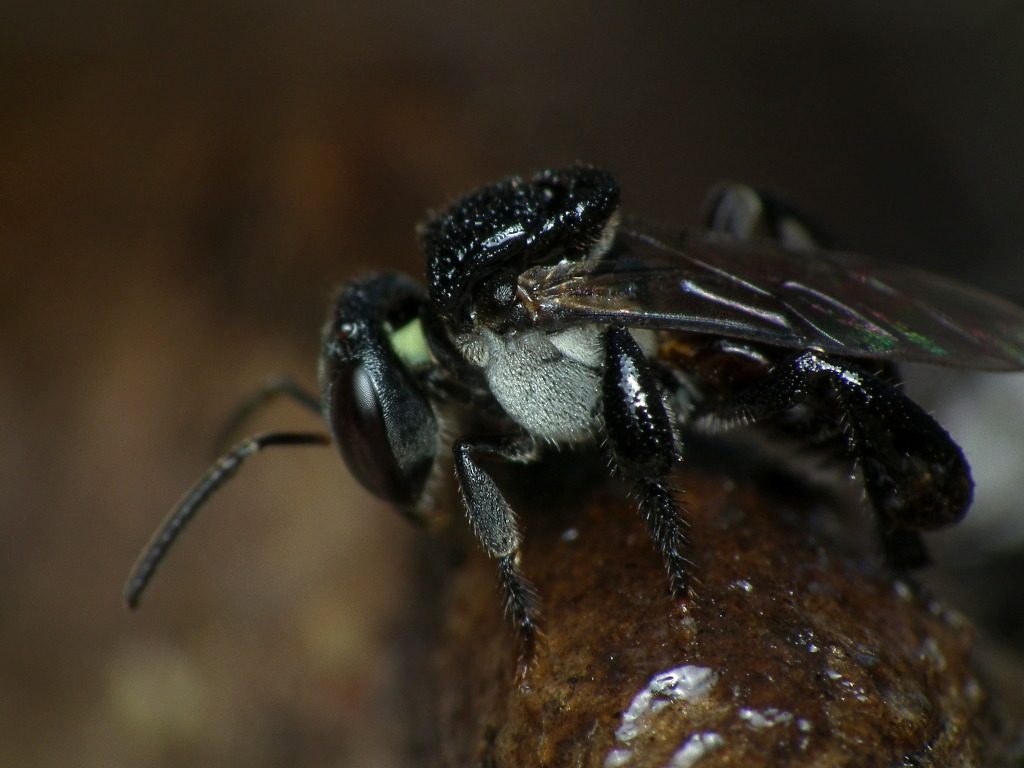
Hive fashion has arrived in the same suburbs. Tetragonula — sugarbag bees, the small black stingless bees of the warmer east and north — are now a patio object, a school project, a gift for the person who already has sourdough. Some of those hives are well kept. Some are a slow death in a climate the colony did not choose. Meanwhile the leaf-cutter in the fence post, the blue-banded bee in the bare patch beside the path, the resin bee using last year's beetle hole, go on being the actual habitat. They were never going to trend.
Tetragonula, which is a real animal
Sugarbag bees are social, stingless, and limited by cold. They belong in the tropics and subtropics: coastal Queensland, the north of New South Wales, pockets further south where a mild winter and a knowing keeper can keep a colony alive. A hive on a Melbourne balcony in July is not a conservation act. It is a small, fashionable mortality.
A well-sited box faces morning sun, is sheltered from the afternoon furnace, and is not moved every time the deck is restained. The colony needs blossom through the year and a keeper who will not open the box for guests as if it were a toy. Buying a cheap split from a stranger is how disease travels. Aboriginal use of sugarbag is a cultural practice with authority this journal does not hold; a suburban hobby hive is not a continuation of that practice just because the species is native. Honey from a backyard hive is a teaspoon economy. Do not treat a stingless hive as a substitute for flowers. A colony in a concrete yard with one grevillea is a livestock problem, not a habitat.
Solitary bees, who were already at work
Most native bees do not live in a box. Females of many species nest alone in soil, in pithy stems, in beetle galleries, in a hole a previous insect left in hardwood. Blue-banded bees — the ones people notice, metallic and loud on a tomato flower — often nest in banks of bare earth or in adobe. Reed bees use twigs. Resin bees seal cells with collected gum. Leaf-cutters take neat semicircles from a rose or a native buddleia and are not vandals; they are builders.
The backyard offer is almost insultingly plain. Leave a patch of untilled, unmulched ground in the sun, even a small one. Do not love every stem into the green-waste the week after flowering; some nests are inside. A bee hotel — a block of untreated timber with holes of mixed small diameters, or a bundle of hollow stems replaced each year or two — can help the stem-nesters if it is kept dry, in morning sun, and not allowed to become a condominium for pests and mould. A decorative hotel bought as an object and left to rot is a disease reservoir. Maintenance is the habitat.
Pesticides are the other half of the offer, which is to say the withdrawal of an offer. A yard that also grows food has to hold both ideas at once: fruit you can eat, and insects you do not automatically treat as an interruption. That tension is practical, not poetic, and it belongs next to growing food in Australian backyards. A tomato that was not sprayed is a tomato a blue-banded bee can finish.
Flowers through a year, not a weekend
Bees need a sequence, not a spectacle. A single week of bottlebrush and then a bare winter is a feast followed by a lockout. The useful planting is staggered: something in late winter (a grevillea that actually belongs, a westringia, a rosemary that has already naturalised without becoming a villain), spring peas and daisies, summer eucalypt and tea-tree if you have the room, autumn daisies and a late salvia that does not seed into the reserve.
Native plants are not automatically the right plants. A hybrid grevillea bred for a red toothbrush and no nectar is a mannequin. A local species that produces flower in the lean months is the worker. Weeds that flower abundantly — the same plants that rewrite a gully — can feed an insect and still be a bad idea at the fence line. That conflict is real. It is described without romance in weeds that rewrite Australian bushland. Pull the invader and replace the lean month with something that stays put.
A lawn that is only rye is a food desert. Clover, a strip of native violet, a verge allowed to bloom before the slasher: these are a snack. Water in a heatwave is a shallow dish with pebbles. Mulch is good for soil and can bury ground-nesters if it is a continuous rug. Leave a bank.
Hive fashion, and the honeybee in the same street
European honeybees are livestock. They compete with native bees for flower, and they are still the reason many backyard stone-fruit set. A suburban honey hive is a neighbour conversation, not native-bee conservation. The fashion risk is the other way: native hives treated as décor, painted boxes in a climate that will kill the colony, multiple Tetragonula hives on a small block with poor forage. If you cannot keep a house plant in a consistent place, you cannot keep a colony. Schools do this well when they have a mentor, and badly when the hive is a grant outcome and nobody holds the key in January.
Pesticide drift, the quiet neighbour
What you spray does not stay on your rose. The drift, the residue in a puddle, the systemic in a sap that a bee will drink weeks later: these are how a tidy yard becomes a district problem. Neonicotinoids in a nursery plant, a "yard treatment" sold as a quarterly peace of mind, a mosquito fogger run at dusk when many native bees are still on the last flowers — these are not theoretical. They are a chemistry that does not know your fence line.
If you can pick the pest off, pick it off. If you must use something, use the least persistent thing, in the evening after bees have gone, on the plant that needs it. The same instinct — fewer persistent chemicals in a shared place — is the household logic of choosing safer cleaning products. Nursery plants can arrive pre-treated. A "perfect" seedling that nothing has chewed can be a seedling nothing should land on for a month.
The backyard will not delist a species. It can offer a sequence of flowers, a patch of earth, a stem left standing, a hotel that is cleaned, a spray that is not a fog, a Tetragonula colony only if your winter is kind. The rest of Wild Neighbours is weeds, corridors, the animals that will never pollinate your tomato. A bee will use what you left, or it will go, and the lemon tree will still look fine from the kitchen. That is the test. Not the box on the patio. The week in August when something is blooming, and the ground is still bare enough to dig.